Table of contents
- Common Load Types for Box Trucks
- 1. Final-Mile Parcel Delivery
- 2. Retail & Distribution Deliveries
- 3. Less-Than-Truckload (LTL) Freight
- 4. Moving and Relocation Jobs
- 5. Furniture and Appliance Deliveries (White Glove Services)
- 6. Expedited and Niche Loads
- Factors That Affect Your Box Truck Profit
- How to Maximize Your Box Truck Profit
- Turn Miles into Money with the Right Strategy
- Frequently Asked Questions
Common Load Types for Box Trucks
Box trucks might be smaller than big rigs, but they can pack a serious profit punch if used wisely. The box truck market is growing (valued at around $42 billion in 2024 and expected to keep rising), which means demand is there. In today’s booming local freight and delivery market, a box truck owner-operator has more opportunities than ever – yet many still leave money on the table by hauling the wrong kinds of loads or running half-empty. This guide will break down the common box truck load types and reveal exactly how to maximize your earnings with each. Whether you’re delivering retail goods around town or running partial loads across state lines, the goal is the same: keep that truck full, minimize empty miles, and get paid what you’re worth. Let’s dive into the types of loads a box truck can carry and how to make money with a box truck through smart load selection and dispatch strategies.
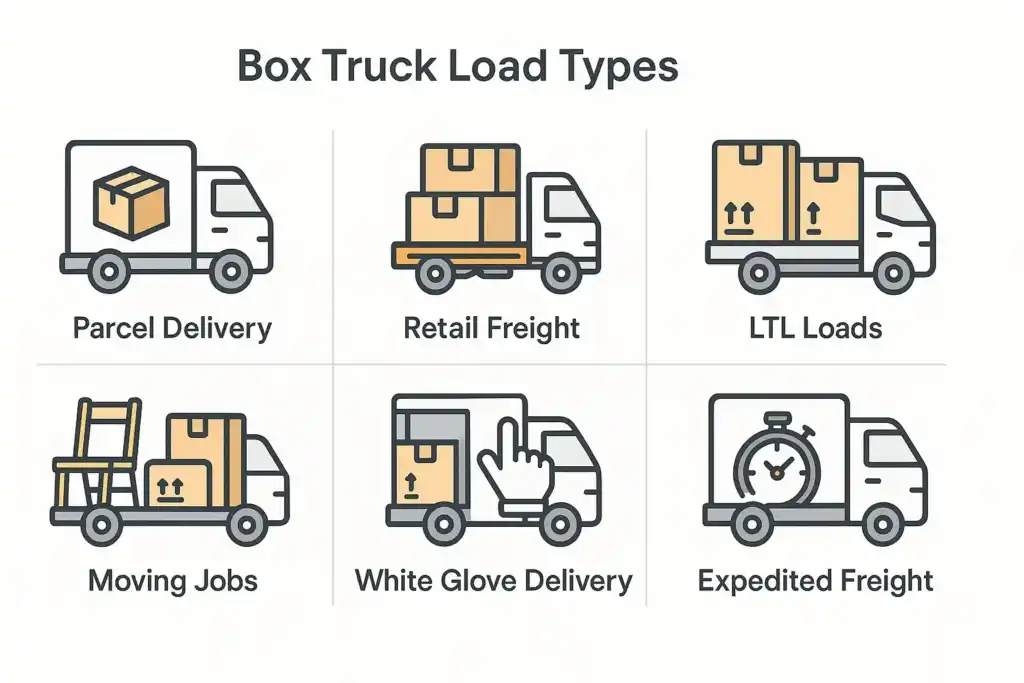
Box trucks (typically 16ft to 26ft straight trucks under 26,000 lbs) are incredibly versatile. From home deliveries to palletized freight, these trucks handle a wide range of jobs. Here are the most common box truck load types and what they entail:
1. Final-Mile Parcel Delivery
This is the classic last-mile delivery work that box trucks often perform for e-commerce and parcel companies. It involves hauling packages or online orders from a local hub to customers’ doors. Box trucks can carry a high volume of parcels and make multiple stops in a day. For example, you might contract with a courier company or retailer to deliver everything from electronics to small furniture in a metro area. Final-mile loads typically involve frequent stops and navigating city streets.
Profit Tips: Final-mile routes pay per delivery or route rather than high per-mile rates, so efficiency is key. Plan your delivery sequence to avoid backtracking and idle time. Many drivers use route optimization apps to cluster stops by neighborhood. Also, be aware of accessorial charges – if you have to carry heavy items up stairs or assemble products, charge extra for those services. Profit on parcel routes comes from doing as many stops as possible in a shift without excess driving between them.
2. Retail & Distribution Deliveries
Retail stores and distribution centers frequently rely on box trucks for regional deliveries. This category includes hauling palletized goods from warehouses to retail locations or small businesses. For instance, a 24′ or 26′ box truck might deliver a few pallets of inventory to multiple stores in one day. These loads often originate from distribution centers of big-box retailers, wholesalers, or food distributors. Unlike parcel delivery, these involve larger, pallet-sized shipments (e.g. delivering 5 pallets of merchandise to a chain store). Many of these loads require the truck to have a liftgate if the receiver has no loading dock.
Profit Tips: Retail loads can pay well, especially if they are urgent restocks or multi-stop runs. Try to schedule multiple deliveries in the same trip – if you’re going to one store in an area, see if you can add another delivery nearby to maximize your day. Always invest in basic equipment like a pallet jack and straps so you can handle these loads safely and quickly (and justify a higher rate). If you serve grocery or food distributors, consider a refrigeration unit – temperature-controlled box truck loads (like delivering produce or frozen foods) command higher rates due to the specialized service.
3. Less-Than-Truckload (LTL) Freight
Many owner-operators find that partial loads and LTL freight are the real money-makers for box trucks. LTL freight means you carry freight for multiple shippers on the same truck, combining loads that don’t fill an entire 53′ trailer. A 26′ box truck, for example, can fit 10+ standard pallets, so you might take two or three smaller shipments from different customers on one route. These loads can be regional or even long-distance – essentially doing the job of a big rig on a smaller scale. Common LTL box truck freight includes things like manufacturing parts, electronics, appliances, or any palletized goods that need quicker delivery than standard LTL carriers offer.
Profit Tips:Combining loads is one of the best ways to maximize profit with a box truck. Instead of hauling one partial load for $500, you could haul three partials that each pay $400 on the same trip, turning it into a $1,200 haul. Work with a dispatcher or use load boards to find compatible shipments (e.g. two loads headed from the same metro area toward the same direction). Just be mindful of your truck’s weight and space – don’t overcommit if the freight won’t physically fit. Also, communicate with brokers about being a “partial” carrier: often brokers post loads that only fill 12 or 14 feet of space. If you can take two of those at once, negotiate a good rate for each. Many savvy box truck dispatchersexcel at pairing partials so you get a full truck’s pay for a half-truck load.
4. Moving and Relocation Jobs
Box trucks are a staple of the moving industry. Residential moves, small office moves, and furniture delivery jobs often use 24–26 foot box trucks (think rental trucks like U-Haul size, but operated by independent movers). As an owner-operator, you can either subcontract for established moving companies or find your own customers for local moves. These loads typically involve household goods, furniture, and personal items. They may be short-distance (within the same city) or regional. Moving jobs are often seasonal (peaking in summer) and are labor-intensive – often requiring you to help load and unload or even provide a team of movers.
Profit Tips: Moving services can be very profitable if you plan well and price them right. Charge by the hour and by distance, and don’t forget fees for things like packing, stairs, or long-carry (when you can’t park close to the door). If you schedule moves, try to book them back-to-back on weekends or end-of-month when demand is highest. Another tip: offer basic “load and go” service where the client packs their own boxes and you simply transport – this lets you earn with less labor time. Also, invest in moving equipment (dollies, moving blankets, straps) to work faster and protect goods – this leads to better reviews and more referrals, which means more business.
5. Furniture and Appliance Deliveries (White Glove Services)
Beyond general retail, many box truck operators specialize in delivering large items like furniture, appliances, or building materials to homes and businesses. These loads might come from furniture stores, home improvement retailers, or warehouses, and often they’re “one-off” deliveries of big pieces (e.g. delivering a couch and dresser to a customer’s house, or a commercial freezer to a restaurant). Sometimes these are white glove deliveries, meaning you might be expected to bring the item inside, set it up, or remove old equipment. Box trucks are ideal for this because they’re enclosed (weather-protective) and usually have a lift gate for heavy items.
Profit Tips: Always charge appropriately for white glove service – if you or a helper are installing appliances or carrying sofas upstairs, build in a hefty labor fee. These deliveries can pay much more than standard dock-to-dock freight because of the extra service level. Make sure to schedule efficiently: if you have two deliveries in the same region, do them on the same run to save fuel. Partnering with local furniture stores or appliance outlets can provide a steady stream of jobs. They often need reliable independent drivers and will pay a premium for good service since it reflects on their customer satisfaction.
6. Expedited and Niche Loads
Some box truck opportunities don’t fall neatly into the above categories but can be lucrative. Expedited freight is a big one – when a manufacturer needs a part delivered today to avoid a factory shutdown, they might pay top dollar for a straight truck to drive it 300 miles ASAP. Similarly, medical equipment or trade show exhibits might require special handling or exact schedules. If you have a refrigerated box truck, you can haul pharmaceuticals or high-value perishables under tight temperature control. These niche loads often come through specialty brokers or dispatch services that know you have the right equipment.
Profit Tips: To capitalize on niche loads, advertise your capabilities. If you have a reefer box, let brokers in your network know you can haul cold chain products (which many box trucks can’t). If you’re available for last-minute runs, list yourself on expedited load boards or apps – shippers will pay a premium for urgent delivery. Just be careful to account for the extra costs (e.g. running overnight or using refrigeration fuel). Niche freight can also mean hazardous materials in small quantities or oversize items that fit in a box truck (e.g. an extra-tall item that requires the full 8-foot interior height). Get any required endorsements or equipment if you want to tap these markets. A single specialized run can sometimes pay as much as a week’s worth of routine deliveries, so it’s worth positioning yourself for them.
Factors That Affect Your Box Truck Profit
Understanding what drives profit (or loss) for a box truck operation is crucial. It’s not just about how high the rate is on a load – many other factors come into play. Here are the key things that affect your bottom line as a box truck owner-operator:
- Distance and Deadhead: Short local hops versus long interstate runs will have different cost structures. Box trucks often do better on shorter routes (less fuel, home nightly) but those runs can have more unpaid time (like loading at multiple stops). Meanwhile, longer runs might pay more per trip but could leave you deadheading (driving empty) back if you can’t find a return load. Always consider if a load’s pay justifies the total miles (including any empty return). A good practice is to plan backhauls in advance – for example, if you take a load from Dallas to Houston, line up another load out of Houston back toward home to cover those return miles.
- Load Availability in Your Region: Your profit potential is tied to the demand for box truck freight where you operate. Urban areas or logistics hubs usually have more loads (and competition) while rural areas might have fewer opportunities but less competition. For instance, a box truck in the Midwest might find plenty of manufacturing LTL loads, whereas one in a small town might rely on a few local contracts. Knowing the freight trends in your lanes can help – some regions or seasons surge with certain load types (e.g. retail loads spike before holidays, moving jobs spike in summer). Stay flexible: if your area is slow, consider running in a nearby hotter market temporarily.
- Rates and Negotiation: Box truck rates can vary widely. As a rule, specialized or time-sensitive loads pay more than generic ones. An owner-operator hauling critical medical supplies overnight can earn far more per mile than one delivering general retail goods. Always negotiate and know your costs per mile. If a broker offers $1.50/mile but you know you need $2.00 to be profitable (after fuel, insurance, etc.), don’t be afraid to counter higher or pass on the load. Also, factor in any extra services – if a load requires driver assist (you loading/unloading) or has tolls, include those in your rate. The most profitable box truck drivers have learned to charge for every service they provide.
- Operating Costs: Profit is revenue minus expenses, so controlling your costs directly boosts profit. Key expenses for box trucks include fuel, maintenance, insurance, tires, and possibly hiring a driver or helper. Fuel economy for box trucks is better than big rigs, but city driving can still guzzle gas with all the stops. Keep up with maintenance – a well-tuned truck uses less fuel and avoids costly breakdowns. Shop around for insurance to get the best rate (box truck insurance for an owner-operator can be pricey, so maintaining a clean driving record and safety devices can help lower it). Also, consider that not needing a CDL (if under 26,000 lbs) means you can potentially hire from a larger driver pool at slightly lower wages if you expand – but always use qualified, safe drivers to avoid accidents that will cost far more.
- Use of Time: In the trucking world, time is money, especially for a local/regional truck. If you spend 4 hours sitting at a warehouse waiting to be loaded, that’s time you could have done another trip. Try to work with shippers and brokers who have quick loading/unloading or ask about average wait times. Some owner-operators charge detention fees if a load takes too long to get loaded. Additionally, the time spent searching for loads or doing paperwork is non-driving time that yields no income. Many box truck owners end up working with a dispatch service or load planner to reduce this downtime – letting someone else find the next load while you’re still delivering the current one means you finish one job and already have the next lined up.
Next, let’s look at specific strategies you can use to maximize profit given these factors.
How to Maximize Your Box Truck Profit
By now it’s clear that what you haul and how you haul it determine your earnings. Now we’ll break down actionable strategies to maximize profit for box truck owner-operators. These tips address load choice, planning, cost control, and more:
- Prioritize High-Paying Load Types: Focus on loads that pay above-average rates. Generally, urgent, specialized, or multi-stop loads can yield more than simple one-drop runs. For example, two partial LTL loads going the same direction will usually pay more combined than a single full load on that route. Likewise, an expedited load needed in 5 hours or a delicate medical equipment delivery can command premium pricing. Don’t be afraid to specialize – if you become known as the go-to for, say, medical courier box truck loads or retail fixture deliveries, you can often set higher rates due to your proven expertise.
- Combine and Conquer: This was mentioned earlier, but it’s worth emphasizing: whenever possible, combine loads. Running half-empty is wasted potential. If you have space and weight capacity, take on an extra partial. Successful box truck dispatchers routinely look for a second (or third) load to fill their truck. Even if each load alone pays modestly, two modest loads can beat one good load. It takes coordination and sometimes creative scheduling, but combining freight is how many owner-operators boost their weekly gross significantly. For instance, a driver who used to haul one pallet load at $1.50/mile started pairing it with a second pallet from a different shipper – now that truck earns over $3.00/mile on the same lane because it’s moving two customers’ freight at once.
- Minimize Deadhead Miles: Every mile your truck drives empty is pure cost with no revenue. To maximize profit, you want as few empty miles as possible. Plan your routes with return loads or a loop in mind. Use load boards or a truck dispatch service to secure a backhaul before you even drop off the outbound load. Even if a backhaul pays a bit less, it’s covering your fuel and putting money in your pocket on the return trip. Another tactic is to relocate smartly: if you deliver in a freight desert (an area with few loads out), consider deadheading short to a nearby city with better load availability rather than all the way home. In other words, reposition to where the loads are, rather than wasting hundreds of empty miles. Over time, track your deadhead percentage; aim to keep it as low as you can (experienced operators often keep empty miles under 15-20% of total miles).
- Use Load Boards and Networking: In the modern trucking industry, information is gold. Subscribe to a couple of good load boards (DAT, Truckstop, etc.) that have straight-truck/box truck categories. Set up alerts for loads fitting your truck size and lanes. Beyond boards, network with local brokers and shippers. A lot of the best box truck loads never even make it to public boards – they’re given to known carriers. Introduce yourself to brokers who handle LTL freight, final-mile logistics companies, and even other trucking companies that might subcontract overflow work. Building relationships can lead to regular lanes or first call on lucrative loads. Remember, if you consistently show up on time and do a good job, brokers will want to call you again. That consistent work at decent rates beats scrambling for spot loads every day.
- Control Your Expenses Ruthlessly: Every dollar you save on expenses is a dollar of profit. Simple steps add up: drive at fuel-efficient speeds (rapid starts and stops in city driving can’t always be helped, but avoid unnecessary idling). Use fuel cards or apps to find cheaper fuel along your route. Keep up with tire pressure and oil changes – well-maintained trucks run more efficiently and avoid breakdowns that can sideline you for days. Also, consider your route choices; sometimes a slightly longer highway route at steady speed is more fuel-efficient (and faster) than a shorter stop-and-go route. When it comes to maintenance, preventive maintenance is far cheaper than emergency repairs on the road. Set aside a maintenance fund from your earnings so you’re not caught off guard by a big repair. Lower operating costs directly translate to a lower break-even point, meaning more of each load’s revenue goes into your pocket.
- Optimize Your Scheduling: Time management can boost profits in surprising ways. Plan your week to maximize loaded hours. For instance, if you can do two short runs in a day rather than one long run, you might earn more total. Some owner-operators like to knock out an early morning local delivery, then do an afternoon LTL run, effectively doubling up in one day. Also, try to avoid downtime during business hours – if you must take a break (for maintenance, etc.), do it in the evenings or early mornings when fewer loads move. Basically, treat your driving hours as precious – use them to move something that’s paying. The more loads or miles you fit into your available hours (without violating any hours-of-service rules), the higher your weekly revenue. Just be careful to not over-extend yourself; stay safe and legal, but plan ahead so you’re almost never stuck wondering “what’s next?” at 10 a.m. on a Tuesday.
- Invest in Equipment That Expands Opportunities: A few smart investments can open the door to higher-paying freight. The classic example is a liftgate – if your box truck doesn’t have one, adding a liftgate can enable you to take loads where no dock is available, and many shippers will specifically seek trucks with liftgate (and often pay extra for liftgate service). Another example is adding E-track and cargo bars inside your box: this helps secure mixed loads so you can safely carry partials without freight shifting – important if you’re combining odd-sized shipments. If your business plan permits, consider a reefer (refrigeration) unit for your next box truck or as an upgrade – it’s a significant cost, but as noted, refrigerated loads usually pay more. Even something simple like keeping a pallet jack and dolly on board can justify higher rates because you can handle more delivery scenarios independently. The bottom line is, the more types of loads you can safely haul (and the more value-added services you can offer), the more you can earn.
- Partner with a Dispatch Service: Many owner-operators find that working with a professional dispatch service is a game-changer for profitability. A good dispatcher acts like your personal load manager – they scour load boards and broker contacts for the best-paying freight, negotiate rates on your behalf, and handle a lot of paperwork and check-calls while you focus on driving. For a box truck operator who doesn’t want to spend hours each day on the phone or computer lining up loads, this is invaluable. Dispatch services typically charge a percentage (for example, 5-10% of the load), but if they can consistently get you 20% higher-paying loads or keep you loaded more days of the week, you come out ahead. They can also help you combine partial loads (which is hard to coordinate solo) and ensure you’re not running empty. Essentially, a box truck dispatch service works to keep your truck at its earning potential at all times. If you’re finding it tough to juggle finding loads and driving, teaming up with a dispatch company like Dispatch Republic’s box truck dispatch team could significantly boost your profits while reducing your stress.
Turn Miles into Money with the Right Strategy
In the competitive trucking landscape of 2025, running a box truck profitably requires more than just hard work – it demands a smart game plan. We’ve covered how choosing the right box truck loads and optimizing every aspect of your operation can substantially increase your earnings. Now it’s time to put these insights into action. Analyze your current hauls: are you maximizing your truck’s capacity and focusing on higher-paying opportunities? If not, make a change today.
At Dispatch Republic, we specialize in helping box truck owner-operators succeed. From combining partials to planning efficient routes, we act as your strategic dispatch partner to ensure you’re earning top dollar on every mile. You don’t have to navigate the load market alone. Boldly take the next step – let’s maximize your box truck profit together. Reach out to our team and see how our professional dispatch service can keep your truck loaded with the best freight.
Ready to make the most of your trucking business? 🚚💨 Reach out to Dispatch Republic and let our experts help maximize your earnings with tailored box trucks dispatch service and flatbed dispatch service solutions. We’ll handle the logistics while you keep on truckin’. Contact us today to get started on the road to greater profits and less hassle!
For more detailed guides, check Dispatch Republic’s resources on dispatching and the trucking business. Read ELD compliance: What Dispatchers Need to Know About Electronic Logs if you’re weighing career paths, and How to Become a Truck Dispatcher to understand the dispatch side of the business.
If you’re an owner-operator juggling multiple responsibilities, consider partnering with a professional truck dispatch service to take the load off your shoulders—literally. At Dispatch Republic, we specialize in helping carriers run smarter and earn more by expertly managing load boards, negotiating top rates, and handling paperwork for dry vans, reefers, flatbeds, box trucks, step decks, and even hotshots. Our team monitors multiple premium load boards around the clock, ensuring your truck stays loaded with the right freight, at the right rate, on the right lane. Whether you’re scaling up or just getting started, having a dedicated dispatch team in your corner means fewer empty miles, less stress, and more time to focus on driving and growing your business.
Frequently Asked Questions
A box truck can carry a wide variety of loads. Common types include palletized freight (such as retail goods, inventory, or supplies on pallets), parcel delivery loads for last-mile e-commerce shipments, residential moves or furniture (when people use box trucks for moving jobs), and appliance or equipment deliveries. Some box trucks are equipped as reefers (refrigerated), allowing transport of perishable foods or pharmaceuticals. Essentially, any freight that fits within the truck’s dimensions (and weight limit) can be hauled – from small LTL shipments to large household items. The key is that box trucks are enclosed and often dock-height, so they excel at moving goods that need protection and easy loading at docks or with liftgates.
Finding quality loads requires using a mix of tools and building relationships. Many owner-operators start with load boards – there are load boards that list straight truck or LTL loads (DAT and Truckstop are popular options; also look at any boards specializing in box truck loads). When using load boards, use filters for your truck size (e.g. 26 ft, 10,000 lb capacity) so you see relevant postings. Beyond boards, it’s important to network with freight brokers and local businesses. Introduce yourself to brokers who arrange LTL or final-mile deliveries – often the best loads never go public because brokers call a trusted carrier directly. You can also contact local warehouses, retailers, or logistics companies and let them know your truck is available. Sometimes contracting with a dispatch service is an efficient way – they will actively search and negotiate loads for you using their industry contacts. Finally, consider signing up for programs like Amazon Relay (for local Amazon loads) or other dedicated contract opportunities which can provide steady work once you’re approved.
It can be, absolutely – but profitability depends on how you run the business. The box truck market is growing (valued around $42 billion in 2024 and expected to keep rising), which means demand is there. Many retailers and shippers are looking for reliable box truck operators. If you secure decent-paying loads and control your expenses, a box truck can generate solid income. Owner-operators report making anywhere from $$150 to $300+ per day after expenses on consistent routes, but top performers who specialize (for example, handling emergency expedite loads or multi-stop retail runs) can earn even more. On the other hand, if you take low-paying freight or have a lot of empty miles, profits shrink fast. The key factors are getting good rates, minimizing downtime/deadhead, and keeping costs (fuel, maintenance, insurance) in check. In 2025, the freight market has been competitive, so those who find a profitable niche or use dispatching strategy (like combining partial loads) are the ones seeing the best profits. Overall, yes, a box truck business can be profitable if managed well – many single-truck owners are netting strong incomes – but it requires hustle and strategy, not just driving.
To boost your profits, focus on a few key areas: better loads, efficiency, and cost reduction. First, go after higher-paying freight – for instance, consider partial LTL loads or niche services that pay premium (rather than only doing low-paying one-off deliveries). Learning to combine loads is a big profit booster (haul two smaller loads at once to double your revenue on a route). Second, improve efficiency: plan routes to avoid empty trips, use technology (GPS route planners, apps) to reduce wasted time and miles, and keep your truck running (minimize days without loads). Third, cut costs: get the best fuel prices (fuel card programs), perform regular maintenance to avoid expensive repairs, and negotiate good rates on insurance. It’s also wise to track all your expenses and revenue per mile – knowing your numbers helps you identify where to improve. Some owner-operators find that partnering with a dispatch service increases their profits as well, because a good dispatcher will find you better-paying loads and handle negotiations, allowing you to stay productive. In short, increasing profit comes from earning more per mile and spending less per mile – every decision in your business should aim to do one of those two things.
In many cases, no, you do not need a CDL (Commercial Driver’s License) to drive a 26-foot box truck, as long as the truck’s Gross Vehicle Weight Rating (GVWR) is 26,000 lbs or less. Most 26 ft rental trucks or typical box trucks are rated just under the CDL threshold so that they can be driven with a standard driver’s license. However, if the GVWR is 26,001 lbs or more, then a CDL would be required by federal regulations. It’s important to check the exact weight rating of your truck (look at the door jamb sticker). Also note that even if a CDL isn’t required, you still need to follow commercial regulations if you’re hauling freight for hire (like having a DOT number, medical certificate, logbook or ELD if required, etc.). Some states might have additional rules – for example, certain states may require a CDL if you carry hazardous materials regardless of truck size, or have special license classes for vehicles like tow trucks or buses. Always verify with FMCSA guidelines and your state DMV if you’re unsure. Even without a CDL requirement, safe driving and proper qualifications are a must – and if you plan to grow to larger trucks in the future, getting a CDL can be a good idea for flexibility.
Some popular load boards have filters for straight truck or LTL loads suitable for box trucks. DAT Load Board is one of the largest – it allows you to search for LTL or “Straight Box” freight. Truckstop.com is another major board that includes box truck freight listings. There are also more specialized platforms: Amazon Relay offers local and regional loads for 26′ box trucks (you need to meet their requirements to join). Other niche boards and apps include uShip (useful for one-off loads, like moving furniture or equipment where shippers list jobs) and even apps like GoShare or Bungii in metro areas (these connect truck owners with local delivery gigs, though often for smaller vehicles). Additionally, some newer platforms cater to final-mile deliveries or hotshot/expedite freight – it’s worth researching if any apps in your region focus on straight truck work. Remember that load boards are just one tool; the “best” one is the one that consistently has the type of loads you want in the areas you run. Many owner-operators end up using 2-3 boards plus broker contacts to cover all bases. as both a challenge and an opportunity. From what we see, those preparations are well underway, even if autonomous trucks are only in early stages on the roads.
A dispatch service can be extremely helpful for box truck owner-operators who want to maximize earnings without spending all their time hunting for loads. Here’s what a good dispatch service does: they find and book freight for you, focusing on the highest paying loads available that fit your schedule and truck. Dispatchers monitor load boards and industry contacts all day, so they often grab good loads quicker than an individual owner-operator can. They also handle rate negotiation – leveraging their knowledge to get you a better rate from brokers (which many drivers might not realize is even possible). Moreover, a dispatcher will organize your loads efficiently, for example planning a route with multiple stops or setting you up with a backhaul to avoid empty return trips. They take care of paperwork like rate confirmations, broker setup packets, and can assist with compliance (reminding you of needed permits, etc.). Essentially, using a professional box truck dispatch service means you have an experienced partner managing the logistics while you focus on driving and delivering. This can lead to higher weekly revenues and less downtime. Of course, dispatch services aren’t free – they charge a fee or percentage – but a great dispatcher should more than pay for themselves by boosting your loaded miles and rates. Many box truck owners find that after partnering with a dispatch company, their stress goes down and profits go up, because they’re always hauling good loads instead of searching and waiting.
Ready to Take Your Trucking Career to the Next Level?
Whether you’re an owner-operator, a company driver, or a carrier company in need of truck dispatch services, Dispatch Republic is here to help. Our teamof experienced truck dispatchers offers affordable, professional truck dispatch solutions designed to save you time, increase your earnings, and make your business more efficient.
Thinking about outsourcing your truck dispatching? Contact Dispatch Republictoday and move smarter, not harder.
Found our Blog useful? Spread the word:
Check our latest posts:
[latest_posts_grid]
Contact us today to see how our team can support your trucking business.